

Opportunities and challenges for developing circular economy in Vietnam
Communist Review - Global economic growth has achieved great achievements, but along with that is the shortage of natural resources and increasing environmental pollution. To overcome these problems, countries around the world, including Vietnam, are aiming to develop circular economy to address the challenges of economic growth and protect the environment.
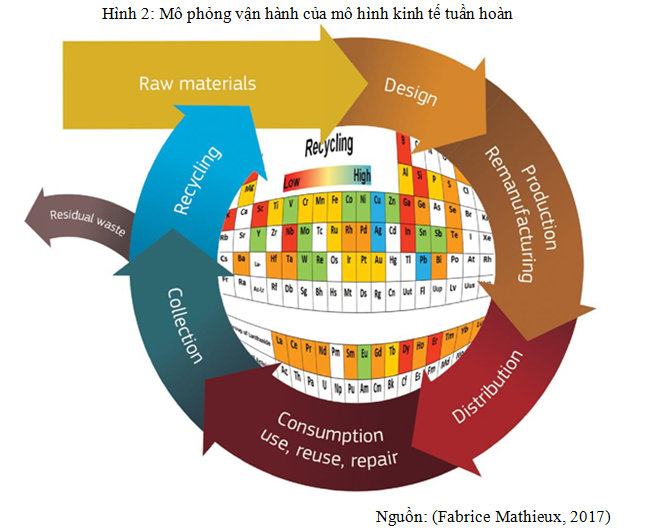
In Vietnam, economic activities so far have mainly relied on a traditional approach, which is the linear economy. This is also the basic cause of the shortage of natural resources and especially serious environmental pollution. In order to implement fast and sustainable development, harmoniously resolve the relationship between economic growth and environmental protection, the appropriate direction is "no trade-off" between economic growth and environmental pollution and degradation, and conversion into circular economy. However, this transition requires opportunities to be seized and challenges to be accepted.
Arguments on the circular economy
Material movement in the economic system from production and consumption
In each economy, capital, labor, science and technology, natural resources are identified as important inputs of the production process. Along with that, economic and living activities dump waste into the environment.
The generalization of Barry Field’s version shows that in order to enhance the economy’s efficiency and sustainability in accordance with the natural environment, economic activities should effectively exploit and use raw resources and minimize the amount of waste released into the environment by reusing and recycling them. This is entirely possible based on the principle of dynamics, the laws of material and energy conservation, the practicality of economic activities, which allows the rotation of waste back into the economic system's input.
The role of the circulatory economy
A circular economy is described as an economic system based on business models that replace the concept of "ending the life cycle" by minimizing, reusing, recycling and recovering materials in production / distribution and consumption at the micro level (production, businesses, consumers), mid-level (eco-industrial parks), macro level (city, region, country and over). Its goals include achieving sustainable development, ensuring good environmental quality, economic prosperity and social justice, meeting current and future benefits. Linear economy is only concerned about the exploitation of resources, production, consumption but not much about its discharging into the environment. Therefore, linear economy maximizes the exploitation of natural resources which leads to huge waste quantities; meanwhile, circular economy focuses on resource management and renewal in closed loops and thus avoids generating waste. Resource utilization comes in various forms, such as redesigning, minimizing, repairing, reusing, recycling, and sharing or renting instead of material possessions.
The transition into a circular economy is a great opportunity for rapid and sustainable development, not only achieving economic, social and environmental goals but also helping to cope with climate change. The transition into a circular economy also heads in the goals of the 2030 Agenda for Sustainable Development. The shifting from linear economy to circular economy brings benefits in the context of resource scarcity and climate change. In addition, this approach is not only adjusted to minimize the negative effects of the traditional economy - linear economy but also a systemic change that creates long-term resilience, business opportunities as well as environmental and social benefits. At the same time, this is also a premise for the implementation of the Sustainable Development Goals (SDGs 2030) by ensuring sustainable production and consumption such as reducing the rate of resource “depletion”, reserving for future generations; raising awareness about reuse and recycle waste, restricting consumption of unnecessary single-use items; expanding manufacturers’ responsibility to support the implementation of 100% rate of recycling waste into raw materials. This is the path towards a low carbon economy, especially in heavy industries. European Union (EU) estimates that the circular economy through its measurement and demand-control activities can reduce more than half the emissions from industries.
Principles of circular economy
Circular economy is an economic system that is restorative and regenerative by design, based on three main principles: Preserve and enhance natural capital, optimize resource yields and foster system effectiveness. In particular, preserve and enhance natural capital by controlling finite stocks and balancing renewable resources flows through restoration, transformation and exchange; optimize resource yields by circulating products, components, and materials at the highest uitility; foster system effectiveness by revealing and designing out negative externalities.
Levels of the circular economy
Circular economy has many different approaches, is divided into three categories in terms of level.
At low level, circular economy focuses on production stage of enterprises and production of agricultural commodities, in which producers are encouraged and required to apply cleaner production methods and eco-design.
At mid-level, circular economy includes the development of eco-industrial parks and other eco-agricultural systems; This design is to provide the best opportunity for implementing circular economy in the operation of businesses.
At high level, all stages of the production process are designed to produce no waste released into the environment. Waste is both minimized and reused.
Opportunities and challenges for developing circular economy in Vietnam
From the arguments about circular economy considering its nature, inner meaning, formation and development to generalize access to circular economy in Vietnam, it is noticed that at present Vietnam does not have adequate circular economy models. Nevertheless, the manifestations of the formation and development of the models that are close to the circular economy appeared quite early in the world, which creates opportunities for developing circular economy in Vietnam, shown as follows:
First, circular economy is a global trend that has been successfully demonstrated in many countries around the world, such as Sweden, Denmark, Finland, Canada, Japan, China, Singapore ..., so Vietnam will learn from the experience of such pioneers and this will go in line with the general trend.
Second, Vietnam is perfecting its socialist-oriented market economy institution; the transformation from "linear economy" to "circular economy" contributes to rapid and sustainable economic development.
Third, encouragement and new mechanisms for the development of the private economic sector in a competitive market will create ample opportunity for its investment in implementing circular economy in the future.
Fourth, we have been heading to the Fourth Industrial Revolution; therefore, implementing circular economy associated with high technology, moving from a physical world to a digital one will be a great opportunity to boost economic growth compared to the previous growth stimulating methods.
Next, the pressure of resource depletion, environmental pollution, huge amount of waste especially plastic one, will be reduced in circular economy. Besides, Vietnam is implementing Sustainable Development Goals (SDGs) and responding to climate change. Adopting circular economy helps to reduce greenhouse gases because they are recovered almost completely, no emissions to the environment. Developing circular economy is exactly the way to achieve many goals and targets of SDGs.
Last, circular economic development will receive high consensus and support from the society since it addresses resource scarcity, environment protection, climate change responses and brings about high economic efficiency.
Apart from the opportunities, the implementation and development of circular economy in Vietnam also faces many challenges, such as:
First, it is a significant challenge to foster full awareness of the circular economy from design to implementation in all sectors and fields among businesses, citizens and managerial levels, and leaders to reach a common consensus.
Second, circular economy is associated with technological innovation and model design while Vietnam is a developing country with outdated technology and small-scale production.
Third, Vietnam has not had a legal corridor for developing circular economy. This issue needs to be resolved; otherwise the implementation of circular economy is spontaneous and subject to market dynamics.
Forth, Vietnam has not developed a set of criteria to identify, evaluate, summarize and give an accurate classification of circular economy development. This is a major challenge to learn to what extent the current economic development in different industries, fields and localities has approached circular economy.
Fifth, circular economy is the culmination of zero-emission approach which requires a truly coordinated sharing of economic benefits. Hence, the challenge to use economic incentives and market mechanisms to engage stakeholders in implementing circular economy is an enormous.
Sixth, the implementation of circular economy requires good experts who are capable of handling stages from designing to the final stage of reuse and recycling of waste. Currently, there is no trained experts in this field and no training majors for these experts.
Seventh, the circular economy requires classification and cleaning of waste before being reused and recycled, which is a great challenge to the practice of Vietnam's economy and the awareness of household sorting of waste at source.
Proposals and recommendations for circular economic development in Vietnam
First, it is necessary to issue a clear legal corridor for the formation and development of circular economy from the Party's policies to the State’s laws. All countries that have been implementing circular economy have adopted transparent laws and regulations. Vietnam needs to build a roadmap and proceeds to formulate a law for circular economy development.
Second, it is necessary to conduct extensive research on circular economy development from a global approach, on principles established by sectors and fields, and on deployment of circular economy’s models and criteria. On such foundation, choose and apply specifically to Vietnam’s practical condition and disseminate knowledge to businesses, individuals and managers.
Third, circular economy development should be supported in the sectors, fields and localities whose economic models have been close to the circular economy approach; thereby the State supplements and makes appropriate suggestions for each sector and field to be piloted and then multiplied.
Forth, build a mechanism to create market dynamics based on the criteria of investment efficiency, encourage businesses and individuals, especially the private sector to invest in circular economy’s sectors, clearly define the role of enterprises in developing circularity.
Fifth, exchange and learn from the world’s experiences, especially from the countries that have been successfully implementing circular economy, then transfer and apply to our country’s particular circumstances. Circular economy models are associated with high technology and the Fourth Industrial Revolution, hence it is essential to formulate policies for the development of clean technologies, reusing and recycling wastes in which wastes become resources of the economy in terms of both production and consumption.
Sixth, implementing circular economy requires a roadmap and development priorities based on market and social demands. For Vietnam, the first priority is plastic bags and waste that must be included in the next 5-year plan to thoroughly solve and minimize the amount of waste dumped into the environment as the fundamental to develop circular economy.
Seventh, the problem that needs immediate resolution in Vietnam is sorting waste at source and then collecting, cleaning, transporting garbage into reuse and recycling. Sorting waste at source must become mandatory and be made a standard of civilized manner among citizens.
In summary, in developing circular economy in Vietnam, it is crucial to understand its nature and arguments. Additionally, it also needs to summarize and evaluate the existing development models in agriculture, industry and service sectors, thereby identify those close to circular economy and support them to approach circular economy development. It is necessary to study and seize the opportunities as well as beware of and overcome the posed challenges in developing circular economy./.


