

From the construction of national fortune to the aspiration for a strong and prosperous nation
Communist Review - As proven through the history of the national and the Communist Party of Viet Nam, the national spirits and aspirations are not only emotional but also rational, which would turn into universal ideals and determination once aroused and promoted. Rational belief is, at its core, the verification of the Party's political principles via practice, in which the national cause and interests, the people's happiness always come first. This is what on which President Ho Chi Minh and the Communist Party of Viet Nam have always insisted.
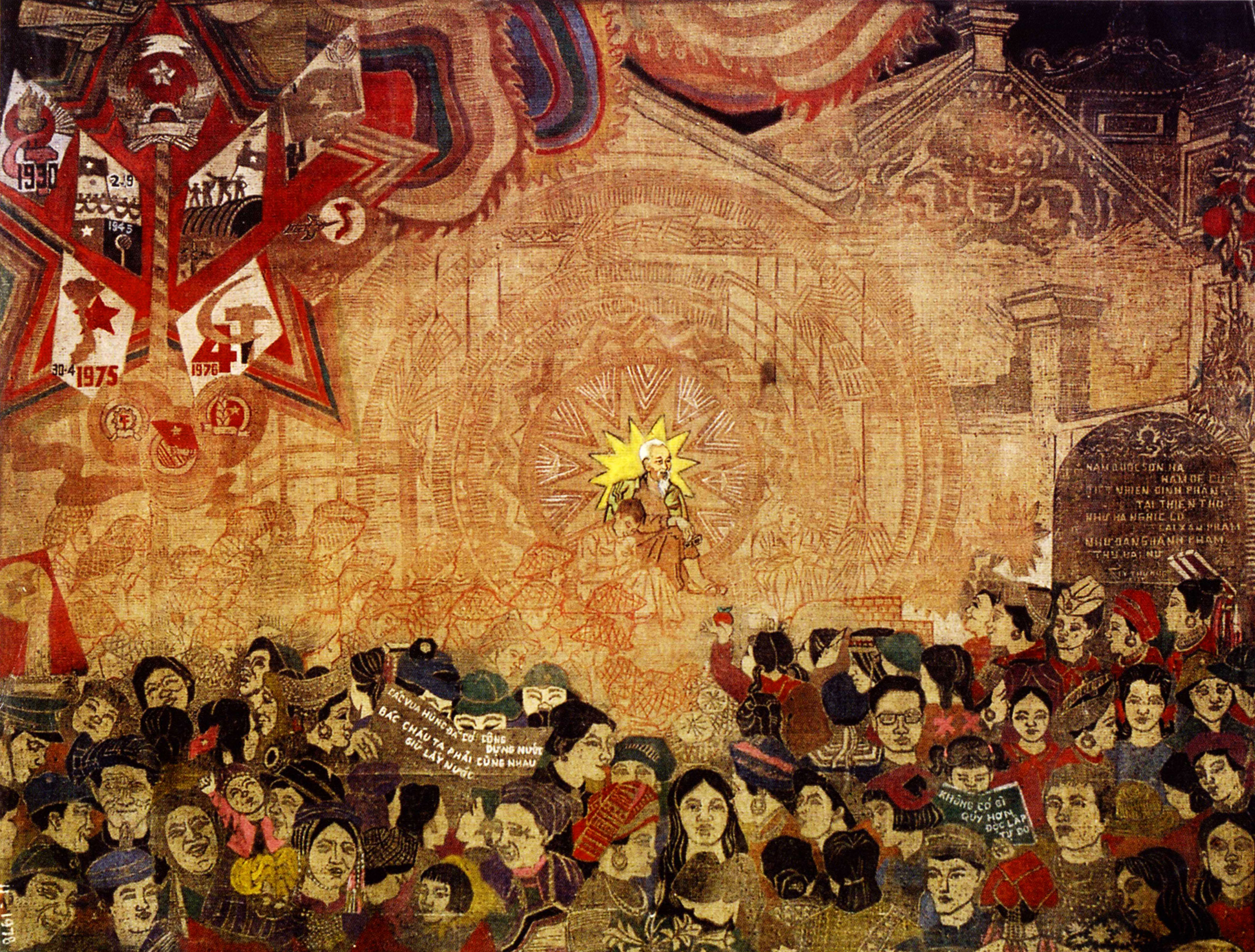
National spirits and aspirations are emotions and rational beliefs, which would become the ideals and will of the entire people when aroused and promoted. (The painting “Uncle Ho’s desires and people’s aspirations” by Tran Nguyen Dan on display at the Viet Nam National Fine Arts Museum) _ Photo: Documentation
Seventy years ago, in September 1945, President Ho Chi Minh wrote in the Letter to students on the very first day of school after the reclamation of national independence and freedom that “Whether our Vietnam becomes beautiful or not, whether Vietnamese people make it to the hall of glory, to stand side by side with strong and great countries of all the five continents or not, it depends tremendously on your studying "(1).
On this day 20 years ago, General Vo Nguyen Giap stated “Looking back on the twentieth century, we see a Viet Nam with brave and intelligent people who accomplished presumably impossible tasks, turning historical reality into legend. Ushering into the 21st century and the new millennium, Vietnamese people with great ambitions and creative intelligence will have seemingly impossible dreams and turn them into historical reality”(2).
In a recent speech, General Secretary and State President Nguyen Phu Trong affirmed “Viet Nam now has greatest ever fortune, potentiality, position and international prestige” (3). Clearly, Viet Nam owes its successes to national renewal over the last nearly 35 years and tireless efforts to realize the nation's mighty aspirations throughout the course of history. At the same time, these lay the foundation for the Vietnamese people to bring into full play their will and aspirations in the era of intellectual civilization, globalization and sustainable development.
National fortune and aspirations throughout history
It can be seen that throughout the history of national construction and defence, Vietnamese people have always proven to be a country of high community cohesion, resilient vitality and lofty aspirations. The content of national aspirations is delivered and passed down from generation to generation in different forms and with diverse contents regulated by specific historical conditions. The overwhelming majority of these are independence, freedom, culture and strength.
Archaeological evidences unveil that as early as the era of Van Lang and Au Lac states, our predecessors did know how to set up an organized, systematic society based on the flourishment of the Red River civilization. Patterns carved on the face of Ngoc Lu bronze drums and the like vividly reproduce festivals of agriculture - river folks, reflecting a densely populated and closely structured society. Discovery of multiple bronze plowshares provides proofs of a pretty organized, advanced wet rice agriculture. In addition, a large number of weapons ranging from rudimentary tools to specialized ones like three-sided arrows, daggers, curved knives, spears and the like serve as evidences of once prosperous residential areas. That is possibly the reason why these lands remain insatiable appetite of foreign invaders.
In such historical conditions, then residents expressed and conveyed their aspirations via legends whose humane messages were clearly unveiled without fanciful shells. They are sense of common roots, community cohesion (“The Birth of the Earth and Water”; “Lac Long Quan - Au Co”), the desire to conquer and master nature (“Son Tinh - Thuy Tinh”, “Mai An Tiem”), unification to fight against foreign invasion (“Thanh Giong”, “Cao Lo”, “Miracle Crossbow”, etc.).
Afterwards, during more than a millennium under the Northern domination, Vietnamese people still haboured their burning desire for independence and freedom. The tougher conditions are, the stronger aspirations are exerted. In 40 AD, no sooner had Hai Ba Trung “launched the insurrection” than leaders and people of all districts responded unanimously, leading to the forced retreat of To Dinh and complete collapse of Han dynasty’s yoke in the blink of an eye.
More than 200 years later, in 248 AD, following the example of Hai Ba Trung, Ba Trieu staged a revolution, saying that “I would rather ride the strong wind, kick the raging waves, slash the fish in Be Dong (East Sea), wipe out realms, in order to save people from misery than imitate those who put up with the status concubines”(4). So terrified of these undocumented determination were Chinese occupiers that an enemy’s commander exclaimed “Fighting a tiger is easy/but encoutering King Ba is really challenging” (5).
By 540 AD, Ly Bi led an insurrection of Giao Chau inhabitants, which resulted in the bankruptcy of Chinese domination and the restoration of autonomy. He founded a new dynasty, proclaimed himself as Nam De and named the nation as Van Xuan with its capital situated in Long Bien. This event clearly showed our forefathers’ courage and aspiration for independence paralleling Chinese dynasties.
In the 10th century, the astounding victory on Bach Dang river in 938 AD marked the shattering collapse of foreign occupation. Ngo Quyen, a representative of people’s will and aspirations, is taunted in recorded documents as a national hero with “battle talent, massive merits” (6). Being considered as the top emperor, he also laid the foundation for national recovery in post-domination period.
During the Ngo, Dinh, and Tien Le dynasties, the independence, autonomy and unification of Viet Nam were further strengthened. Notably, the establishment of Ly dynasty and decision to relocate the capital from Hoa Lu to Dai La in 1010 opened up a new chapter for Dai Viet, that is the posture of a “flying dragon” as literally interpreted from “Thang Long”.
An increasingly sustainable national fortune and position enables Vietnamese people to protect their independence and autonomy. In 1075, having got the news that the Song dynasty gathered troops in bordering districts of Chau Kham and Chau Liem in preparation for Dai Viet invasion then Ly dynasty’s king and aides bravely adopted “preemptive strike” plan so as to restrain and smash invaders. A year later, in 1076, in the midst of the fierce war against the Song invaders, the “divine poem” resounded acting as catalysis of aspirations for national freedom, independence “The mountains and rivers that carved the southern empire, dwelled by the Southern Emperor/Its sovereignty is of nature's will and is allotted in script from the heaven/What gives these invaders the right to trespass it/They shall, in doing that, see themselves be defeated and shamed!”(7).
The anonymous poem has been recorded as Viet Nam’s first declaration of independence. Through Ly and Tran dynasties, the country was more and more stable and prosperous with victories in three resistance wars against Mongolian invaders as hailed in the verse “The eternity of our country has been reaffirmed” (8).
By the beginning of the fifteenth century, after the failure of the resistance war led by Ho Quy Ly and his son, our country once again fell into the yoke of brutal domination by the Northern enemy. Emperor of Minh dynasty personally ordered Truong Phu and other commanders of the so-called “Heaven Dynasty” army to destroy, confiscate and seize anything on the way to Thang Long, be it stele, book or talent. The ultimate purpose of this policy is to force locals to forget their roots, eliminate cultural foundation, thereby put an end to their will and aspirations for independence and freedom.
Under the leadership of Le Loi, Nguyen Trai and other eminent patriots, our people unanimously engaged and wiped out Ming army. National pride and aspirations were once again fulfilled as reviewed in Binh Ngo Dai Cao (Proclamation of victory) “As to Dai Viet, a country of great culture with a long tradition, its mountains and rivers are lawfully delineated/In addition, our customs are different from those in the North/For hundreds of years, the dynasties of Trieu, Dinh, Ly and Tran had firmly established their independence/Like the Han, Tang, Song and Yuan of China they proudly governed their lands/Although their strength, their weakness and ours at times differed, men of noble character in our country were never in short supply”. Once again, Viet Nam had its sovereignty restored, cultural identity preserved.
Since then, Dai Viet saw a substantial improvement in its fortune and position. Thanks to a well - planned wet rice agricultural economy, local culture flourished brilliantly, along with territorial expansion to the south and the peacefully sustainable integration of other residential clusters into Vietnamese ethnic community. Even when the country fell into separation between Le - Mac and then Trinh - Nguyen, national inner strength was still constantly being accreted. By the end of the eighteenth century, Viet Nam was indeed a powerhouse in Southeast Asia. That Tay Son, a newborn dynasty, quickly defeated Siamese invasions in the south (1785) and Qing army in the north (1789) proved the position, strength and the will of Viet Nam at that time. The “Hich” (mobilization), which was believed to be delivered by Emperor Quang Trung at the military departure ceremony before the Lunar New Year's Eve (1789), illustrate strong desire for national independence and freedom “Fight for long hair!/fight for blackened teeth/Fight until the enemy has no way back/Hit him the incomplete plate!/Fight for historical affirmation of the owners on the southern land”(10).
By the second half of the nineteenth century, the country fell into bondage by French colonialists for many reasons. Generations of Vietnamese people stood up to the enemies, demonstrating the determination to “wash the stains of slaves with hot blood” and regain independence and freedom. It was against this backdrop of the bloody struggle that national aspirations were fulfilled. In new historical context, beside burning desire to restore independence and freedom, there was an increase in locals’ aspirations for a new, powerful, democratic Viet Nam in a fiercely competitive world of “might is right”. This presented an unprecedented content and higher level of Viet Nam's national vision and aspirations, acting as the ideological flag of the patriotic movements in the early twentieth century led by progressive Confucian scholars, with Phan Boi Chau and Phan Chau Trinh being the most eminent leaders.
Immersed themselves in “Western rain, Oriental win”, under the impacts of Western bourgeois democracy, generations of progressive Confucian scholars strived to “unlock” inherent limitations of patriot movements, called on the masses to rise up and proactively absorb the Western quintessence, especially educational principle of “practical studies” to promote “real career”, towards “self-reliance”, that is to renovate the country, and “brighten people’s intellectual, revitalize people’s will and secure social welfare”.
Despite the occasional differences in strategies (violence, renovation) or in forms (Dong Du, Dong Kinh Nghia Thuc, haircut, clothing transformation), these movements shared the ultimate objectives of national independence and renovation. The book “A New Viet Nam” (1907) by Phan Boi Chau is regarded as the platform of the entire Vietnamese patriotic movements in the early twentieth century.
In his work, Phan Boi Chau devoted himself to finding out answers to the following questions: Why did the nation need reforming? What were the goals? Which directions and solutions should be taken? Once these issues were clarified, Vietnamese people would get a future picture of “A New Viet Nam” after successful renovation and bright prospects of the whole country, which encouraged them to bravely, enthusiastically, consistently engage in the Reformation - National Salvage. It was not until the birth of the Communist Party of Viet Nam that the platform stayed the most aspirational document of Vietnamese people in early modern time.
Phan Boi Chau identified a nation of independence, sovereignty and might as the most important goal of the reform. “Once renovation is completed, people’s intellectual will be expanded, people’s awareness will be raised, and civil rights will be exercised; The destiny of Viet Nam will be controlled by Vietnamese people. We are so prosperous, how happy we are!” wrote Phan Boi Chau (11). Accordingly, a new Viet Nam would be characterized by democracy and freedom which would, in turn, pave the way for a future economic powerhouse.
Aspiration by definition is what ones long for and the way they envision the future. Given historical context of the early twentieth century, Phan Boi Chau’s expectations were somehow romantic, but not political paranoia. That once backward countries transformed into prosperous ones like Japan and other Western nations thanks to renovation is a convincing testament to the desire for might.
Foundations laid for national fortune and aspirations - From a historical view
It can be seen that what dominate people’s constant and burning aspirations throughout the history of national construction and defence are independence, freedom, civilization and prosperity. That is the core of Vietnamese patriotism which fortifies the unity bloc and converges the strength of the entire nation, creating political and cultural foundations for the nation's fortune.
That aspiration takes its root right in simple wishes in daily life of Vietnamese people rather than in any abstract political doctrines, religious teachings or the subjective will of any dynasty or “righteous emperors and lords. In order for the entire people to enjoy a peaceful, decent, harmonious and happy life, the country must stay away from foreign invasion, internal chaos beside “expectation for favourable weather conditions” , that is, the nation must be independent, free, and moreover, people must be guaranteed vital conditions for production in a harmonious and compassionate society.
Historical experience drawn from the highs and lows of dynasties from the tenth century to the nineteenth century shows that, to satisfy the aforementioned simple wishes of the people, to sustainably consolidate the national heritage and to make the national aspirations sublimate, become national spirit or not, there must be “holy god, good aides”, “Food security is prerequisite”. Aware of this fact, “wise kings and lords”, “sages and generals” attached great attention to wet rice agriculture. Emperors and subordinates had to perform the most important rituals, such as worshiping Xa Tac, the plowing of Tich Dien fields in hope for abundant crops; superiors also had talented courtiers preserve the dyke work, and local officials take care of irrigation systems; organize reclamation, avoid power abuse and harassment. In case of natural disasters, kings sometimes had to conduct praying ceremonies, or even penitent ceremonies to “restore the heavens’ mercy”. It was believed that if the king performed the job well, then residents were prosperous, the country was peaceful and cheerful. On the contrary, if the king ignored people’s livelihood, or worse, caused famine, poverty, displacement, immigration, people’s trust would erode, society would be on the brink of chaos. In such conditions, if we have to deal with foreign invasion or domestic turmoil, the nation will be put in such a great danger that its fate could not be reversed.
Thus, what makes up the core of national aspirations, visions and will in the history of Viet Nam is not only the philosophy of national welfare for the people, but more importantly, the pioneering, directive spirit toward a bright future.
Vietnamese aspiration, vision and will in Ho Chi Minh era
Adopting Marxism-Leninism, in 1925 Nguyen Ai Quoc founded the Vietnamese Revolutionary Youth League with the nucleus being the Communist community, embarking on the theoretical and organizational preparations for the establishment of a communist party in Viet Nam which could guide the Vietnamese revolution in the direction of proletarian revolution. Between 1925 and 1927, Nguyen Ai Quoc directed the focus toward educating and training the very first cadres, helping young Western-styled intellectuals nurture vision, theoretical knowledge, propaganda, organization, leadership skills and revolutionary moralities.
Learning from valuable lessons drawn from different revolutions in the world, Nguyen Ai Quoc came to the conclusion that “At present, only Russian revolution achieves full success with people enjoying true freedom and equality rather than unreal ones boasted by French imperialist in An Nam (...). The revolution set a lesson for Vietnamese leaders that peasants, a stable party, a sense of persistence, sacrifice and unity are key to a successful revolution. In short, Marxisim and Leninism should be taken as guidance”(12).
“Worker - peasant union is the root of a revolution” which should be brought into full play so that people “can enjoy true happiness and freedom” - that is the core principle of Nguyen Ai Quoc - Ho Chi Minh, the foundation of our Party's political philosophy and the aspiration of the entire nation in mortal struggle for the liberation of the nation, class, society and people as well. From the first political platform (February 1930) with the following objectives: “To overthrow French imperialism and feudalism; the struggle for independence in Viet Nam is associated with freedom of organization, gender equality, education popularization clearly in Party's line. Under the thought flag of the Party, Vietnamese people became more and more united, overcoming fierce challenges to “use our strength to liberate us”, restore independence and unity of the country, establishing the Democratic Republic of Viet Nam in the autumn of 1945.
As soon as national independence was reclaimed, President Ho Chi Minh sent letters to revolutionary authorities of all levels, noting “It would not make any sense if the country is independent in the absence of people’s happiness and freedom. President Ho Chi Minh also outlined political principles for the revolutionary government that “Whatever benefits the people, we must do our best. Whatever harms the people, we must do our best to avoid"(15).
It is notable that national aspiration and political will in President Ho Chi Minh's thoughts are the continuous inheritance from generations of Vietnamese in the thousands-year history of Viet Nam. Such aspiration and have contributed to consolidating the great solidarity bloc, creating an unwavering belief in the leadership of the Party during the two extremely fierce wars between 1945 and 1975.
Before departing this life, President Ho Chi Minh, in his words of the Will, continued to strengthen the country, Party and people’s burning will and aspirations “As long as our land and people still exist, we will defeat American imperialists and build a more advanced country” 16).
President Ho Chi Minh also earnestly told us that “The Party ought to make a careful plan for economic and cultural development, in order to constantly “improve people's lives” (17).
President Ho Chi Minh also foresees accumulated difficulties in rebuilding the country in the postwar period, giving special instructions that “The above - mentioned duty is not only heavy and complicated but also very glorious. It is a fight against the old, the spoiled for new, better things. To get the victory in this massive battle, we must have the entire people encouraged, organized and educated with the great force of the people being the basis”(18). “What needs to be done first is to rectify the Party, making each party member, each member of the Youth union, each party branch strive to fulfill assigned tasks and wholeheartedly serve the people" (19).
The purpose of the Party reorganization is to make the Party stronger, commensurate with its duties and role as the ruling party, representing the will and aspirations of the entire nation. President Ho Chi Minh put it “The Communist Party of Viet Nam is the ruling party whose every single member and official must be truly imbued with revolutionary morality including thrift, integrity, righteousness, public spirit and selflessness. It is their duty to keep the Communist Party of Viet Nam transparent and worthy of leadership and faithful servant of the people”(20). President Ho Chi Minh affirmed that if these were secured, no matter how tough the tasks were, Vietnamese people would definitely get them done.
For more than half a century, the Party and people of Viet Nam have endeavored to comply with the instructions and guidelines of President Ho Chi Minh, which results in the most ever huge career, position, international prestige. Looking back on that journey, especially the country's journey since the Great Victory in Spring 1975, some important lessons can be learnt.
Firstly, the lesson on “motivating the entire people, organizing and educating the entire people, relying on the great force of the entire people". This is what the Communist Party of Viet Nam has succeeded during the struggle for power reclamation and revolutionary wars. As a result, Vietnamese revolution has overcome all challenges and gained glorious feats in the twentieth century. However, in the post - war period, the lesson on gathering people’s strength, as advised by President Ho Chi Minh, were not always thoroughly grasped and implemented effectively. Subjective mistakes in the period of 1975 - 1986 did cause “serious erosion of trust” in the public. Being aware of this shortcoming, the Party, at the beginning of national reform, introduced the slogan “people as the root”, implemented three major economic programs (food, consumer goods and exports) and took care of people's material and spiritual life. As a result, Viet Nam overcame the period of socio-economic crisis with insurmountable difficulties in the early years of renovation.
Even in the renovation period, there were occasional breakage, or even serious violations in the relationship between the Party and the people, the government and the people. Hotspots and uncertainty broke out in multiple localities like Thai Binh (1996-1997), Central Highland, Northwest and more recently in Thu Thiem (Ho Chi Minh City), in Dong Tam (Hanoi) and so on. The violation against Party disciplines and laws among cadres, party members, even high - ranking officials, servicemen has adverse impacts on people's trust in the regime and country's future.
Against this backdrop, the Communist Party of Viet Nam has made appropriate and correct decisions in accordance with particular issues. Such breakthrough, timely and sound economic policies as contracting policies in agriculture, anti - inflation policies, policies on multi - component commodity economy, socialist - oriented market, international integration, integration, competitiveness improvement and the like have not only lifted Viet Nam out of poverty, but also turned it into a dynamic developing country with efforts to narrow the gap with other countries in the region and around the world.
Along with the increasingly cohesive and extensive innovation policies in all fields, the campaign to rectify the Party, the resolute and effective battle against corruption, waste and other economic crimes have fostered people's trust in the leadership of the Party and in the promising revolution cause. Most recently, initial efforts and successes in the fight against the COVID-19 pandemic have proven that once the Party and State knows how to utilize people's overall strength, organize, mobilize and multiply the power of the people, they will become “all-people firm citadel”. Sustainable solidarity is always a solid fulcrum for the entire nation to overcome challenges, no matter how huge they are.
Secondly, the ruling Party's pioneering role. President Ho Chi Minh stated “Successful revolution requires a consistent Party like a riding boat needs good sailors” (21). As the ruling party and the nucleus of the reform, the Party plays a pioneering role, which is the deciding factor for the survival of the regime and the destiny of the nation. Viet Nam embarked on the renovation period at the time when there was no precedented path, not to mention embargo, encirclement, the collapse of communism in Soviet Union and Eastern nations on the account of mistaken reforms. In such conditions, the Party's creativity and pioneering role has been clearly shown in its bold decisions and wise choice of steps. Therefore, the country's potentials and fortune have been better and better. Since 1995, the Party's pioneering role has been evident in strategic decisions for Viet Nam to take advantage of the opportunities to open up, gradually integrate with the region and the world, and maintain stability for constant development and more sustainable, comprehensive improvement.
Thirdly, setting good examples of top leaders. Whatever era they live in, from the time of Hung Kings, An Duong Vuong, Hai Ba Trung, Ba Trieu, Tran Nhan Tong, Tran Quoc Tuan, Le Loi, Nguyen Trai, Truong Dinh, Phan Boi Chau, to Ho Chi Minh and the Communist Party of Viet Nam, high - ranking leaders are poised to utmost responsibility in building national fortune. Not only are leaders patriotic, sympathetic, they should be sociable, trustworthy, and share people’s desire. In addition, they must be those who nurture and raise the state of nation's aspirations paralleling contemporary time. Only these criteria are met do leaders present national wisdom, vision and aspirations.
Though it is true that “Although their strength, their weakness and ours at times differed, men of noble character in our country were never in short supply” as stated by Nguyen Trai and Le Loi, we cannot passively wait for their appearance talents in the current era of intellectual civilization and industrial revolution. Instead, the pool of talents must be spotted and nurtured proactively. For that reason, President Ho Chi Minh instructed that “Fostering the future revolutionary generation remains a very important and necessary task” (22).
Fourthly, raising and promoting national spirit. History has suggested that if national spirit is lifted, will and aspirations realized, Vietnamese people will, albeit in tough and decisive moments, overcome all challenges and gain glorious feats . Such events used to be recorded during the country’s history. For instance, the poem “Mountains and Rivers of the Southern” resounded amid the resistance war against Song in 1075; the Dien Hong Conference (1428) where the elders shouted in unison “strike” in response to King Tran Nhan Tong's question about the the Mong Nguyen enemy; the simultaneous reaction of Vietnamese people to smash bondage, “Using our strength to liberate ourselves” at the summons of the Party and supreme leader Nguyen Ai Quoc in the fall of 1945.
In the new context of national construction and defence, the nation's spirit and aspirations for might need to be aroused and promoted in order for us to make concerted efforts to develop the country and safeguard its sovereignty, interests and territorial integrity./.
----------------------------------
(1) Ho Chi Minh: Complete Works, National Political Publishing House, Hanoi, 2011, t. 4, p. 35
(2) Old & Modern Magazine, no.1-2000, p. 3
(3) Nguyen Phu Trong: “Speech of the General Secretary and State President Nguyen Phu Trong at the 130th anniversary of President Ho Chi Minh's birthday”, Nhan Dan Newspaper, issue dated May 18, 2020, https : //nhandan.com.vn/tin-tuc-su-kien/dien-van-cua-tong-bi-thu-chu-tich-nuoc-nguyen-phu-trong-tai-le-ky-niem-130-New-born-standard-ho-chi-minh-458617. Earlier, in his speech on the 90th anniversary of the establishment of the Communist Party of Viet Nam, comrade Nguyen Phu Trong also affirmed: “With great achievements, we have grounds to affirm that our country has never had the same fortune, potentiality, position and prestige as today”. See at: https://baoquocte.vn/toan-van-bai-phat-bieu-cua-tong-bi-thu-chu-tich-nuoc-tai-le-ky-niem-90-nam-ngay-thanh- lap-dang-108832.html; http://dangcongsan.vn/xay-dung-dang/ky-niem-trong-the-90-nam-ngay-thanh-lap-dang-cong-san-viet-nam-547821.html
(4) This statement of Ba Trieu was recorded in the book “Thanh Hoa ky thang” by Vuong Duy Trinh in the nineteenth century, then passed down in form of folklore.
(5) Referred to: Phan Huy Le (Editor – in - chief), Phan Dai Doan, Nguyen Quang Ngoc, Luong Ninh, Tran Quoc Vuong, Vietnamese History, Volume I, Publisher. Viet Nam National University Press, Hanoi, 2014, p. 407
(6), (7) Complete Annals of Dai Viet, Social Science Publishing House, Hanoi, 1998, p. 1, p. 204, 279
(8) Poetry of Emperor Tran Nhan Tong, printed Complete Annals of Dai Viet, Social Science Publishing House, Hanoi, 1998, p. 2, p. 62
(9) Complete Annals of Dai Viet, ibid, t. 2, p. 282
(10) Minh Do history, manuscript saved at the Institute of History, notation HV.285, volume 44. Referred by: Phan Huy Le (Editor), Nguyen Thua Hy, Nguyen Quang Ngoc, Nguyen Hai Ke, Vu Van Quan, Vietnamese History, Publisher National University, Hanoi, 2016, t. 2, p. 602
(11) Phan Boi Chau: Complete Works, Publishing House. Thuan Hoa, Hue, 1990, t. 2, p. 255 - 256
(12) Ho Chi Minh: Complete Works, Publishing House. National Politics Facts, Hanoi, 2011, t. 2, p. 304
(13) Ho Chi Minh: ibid, t. 3, p. first
(14), (15) Ho Chi Minh, ibid, p. 4, p. 64, 65
(16), (17), (18), (19), (20) Ho Chi Minh, ibid, p. 15, p. 623, 612, 617, 616, 611 - 612
(21) Ho Chi Minh: ibid, t. 2, p. 289
(22) Ho Chi Minh: ibid, t. 15, p. 612
This article was published in the Communist Review, No. 949 (September 2020)


